3rd session of the HSR SR | 20 May 2024
23.05.2024 15:14
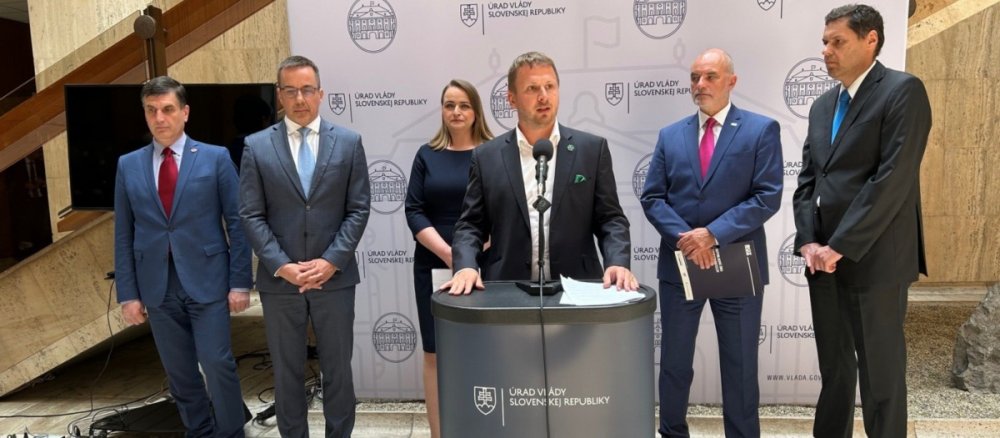
The Ministry of Labour, Social Affairs and Family of the Slovak Republic proposes to increase the minimum wage from the current 57 % to 60 % of the average monthly wage of the previous two years. The changes in the calculation of the minimum wage are part of the transposition of the European Directive on adequate minimum wages. In the proposal of the labour ministry, the surcharges for night work, weekend work and work during holidays are tied to the minimum wage. The new minimum wage according to the new mechanism should apply from 1 January 2026. Industry rejects the proposal.
Why do we disagree with the proposed change?
The European directive recommends that the minimum wage represent 60 % of the median or 50 % of the average wage. Slovakia will reach the parameter of 50 % of the average wage as early as next year. A change in the formula would mean that our ratio would rise to more than 53 %, which is significantly more than in the surrounding countries (41 to 47 %).
Negative impact on business
We perceive the proposal as a political decision under the guise of formal social dialogue. It contains parts going beyond the scope of the EU directive. A change in the formula will have a negative impact on the business environment in the amount of 110 million euros and will further weaken the already low competitiveness of Slovak companies.
An increase in the minimum wage will significantly affect the entire business environment. It will most affect sectors such as transport, construction and healthcare. Nevertheless, the government refuses to mitigate the rise in costs and does not plan to introduce any compensatory measures such as, for example, in the Czech Republic, where they abolished the work-difficulty levels for the private sector.
The problem is the tying of surcharges to the minimum wage
In Slovakia we provide several surcharges at higher percentages and on a broader scale than other countries. These surcharges moreover accumulate. This causes a problem across all economic sectors. After all, not all activities can or should be carried out only during standard working hours. Due to higher surcharges, in Slovakia we carry out constructions, repairs of roads and bridges during the day, some works do not even progress at all during weekends, which needlessly prolongs the construction time.
Conversely, freight carriers cannot run by rail during the day, because freight transport has assigned slots only at night. In surrounding countries, freight trains run on a separate track. We, however, have only one track, which during the day serves passenger trains, so we do not allow freight transport onto it. But we then de facto penalise this forced night-time running with surcharges, even though the state did not create conditions for daytime running. Moreover, we reproach employers for excessive night work, even though they are often forced into it by circumstances.
The Czech Republic, unlike Slovakia, has its surcharges tied to the average wage except for one, namely the surcharge for work in a difficult environment, which is tied to the minimum wage.
We reject the intention to introduce representative higher-level collective agreements
Also beyond the scope of the EU directive is the proposal to reintroduce representative higher-level collective agreements (KZVS). This is an automatic extension of agreements to employers who were not part of the negotiations, did not sign it and may not even have any knowledge of its existence. According to the proposal, even a KZVS covering less than 10 % of the market could become binding for the remaining 90 %, which cannot be called representativeness.
The state in fact forces collective-bargaining coverage through interference in the freedom of contractual relationships by replacing the expression of will and forces employers to submit to the content. We hold that effective and proven tools are and will be company-level collective agreements. From past experience we know that the extension of KZVS had no effect on the growth of the average wage.
You can find the recommendations we advocate for the protection of industry, together with the agenda of the session, on the website of APZD.