Round table on barriers to employing foreigners
03.04.2024 08:14
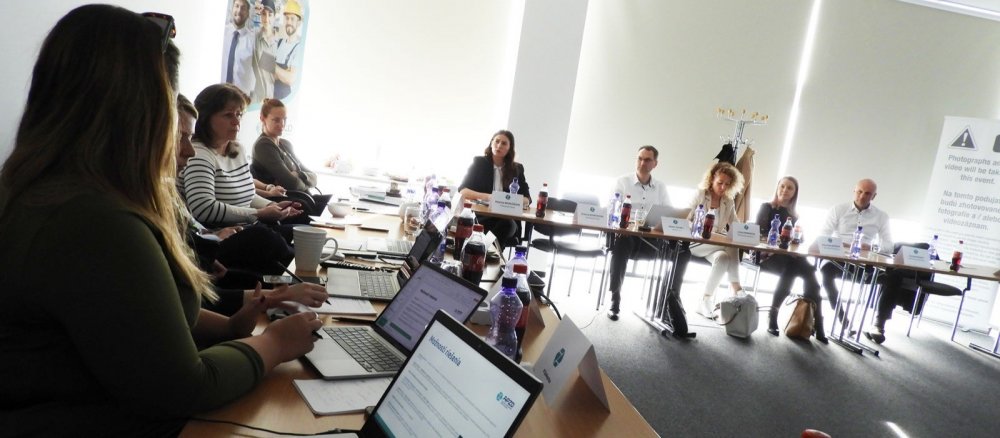
APZD has recently become a leader in the professional field of employing foreigners. The current situation is affected by extensive bureaucracy with too many necessary steps, which prolongs the whole process even further. The APZD initiative has taken the form of a draft law that will be effective from July and under which the applicant no longer has to wait for a decision from the foreign police.
At the round table, which APZD organised in Bratislava on 26 March, a discussion took place with the parties concerned, who also shared their own experience with this issue and at the same time indicated the direction in which this area will develop in the future. The participants included not only delegates of various large employers, but also representatives of the Automotive Industry Association of the Slovak Republic and the Slovak Trade Licence Association.
Since the maximum possible has been achieved in legislation, APZD can begin to focus on further aspects to speed up the legal employment of foreigners. In agreement with employers and with representatives of the ministries, this concerns mainly paid employment intermediaries, hidden temporary assignment and the increase in the number of bogus trade licences among foreign workers. Their activity causes overload of diplomatic missions abroad and a sharp increase in foreign trade-licence holders compared to foreign employees.
Not every agency is the same
Employers provided their numerous experiences with a wide range of fraudulent practices that also burden diplomatic missions in third countries as well as the employers directly. The problem is associated with the activities of certain personnel agencies and their unfair practices.
The question is how employers can defend themselves, since various practices are also carried out by agencies with which cooperation is otherwise standard. The solution is the introduction of similar regulation of employment intermediaries as in the case of temporary employment. Another solution is the option of cancelling them at the initiative of the police or a diplomatic mission. A well-known problem is also the blocking of appointment slots at police units and diplomatic missions, which requires changes to the settings of this system.
Some try to handle cases directly with consulates and other diplomatic missions. The new processes for employing foreigners, however, minimise the room that could be misused, as the foreign police will only accept applications for temporary residence that the labour offices have agreed to in advance.
Some employers raised a proposal for the certification of personnel agencies by APZD, which could make it easier for employers to navigate. This, however, is associated with a number of further problems, due to which APZD may not have sufficient capacity for such an activity.
When an employee does not stay long
Other practices include the effort of some agencies to “poach” a foreign employee from the company that went through the whole process with them from their home country all the way to Slovakia. They achieve this by visiting workers at hostels or even at the medical examination.
Employees are also exposed to the temptation to continue further into the EU due to the proximity of Vienna and essentially also Germany. Foreign employees here cannot be chained down. This becomes an unsolvable problem especially in cases where they are motivated to leave by the personnel agencies themselves, and particularly those that have built their business model on it.
Fictitious trade-licence holders
In Slovakia, the image of a trade-licence holder as a person whose main hobby is optimising spending on contributions and taxes has already taken hold, even though they work as ordinary employees. This reputation is often undeserved and demeans the position of honest trade-licence holders. But the growing interest of foreign workers in setting up trade licences instead of legal employment creates another barrier on the Slovak labour market.
APZD strives to submit solutions to the state before the state itself wants to regulate it haphazardly. Alongside all the other problems with the workforce, employers also have to deal with the fact that many foreigners switch to a trade licence after being trained, with which they are substantially helped by communities of their compatriots or even by personnel agencies. However, this reduces the stability of the workforce for employers.
The rising numbers of temporary residence permits for the purpose of business turn Slovakia into a transit country for fictitious trade-licence holders dispatched to EU countries, which contributes to further overload of offices and police units. Last but not least, this area also sees usury operating in the space of unregulated employment intermediation.
Finding a single universal solution for the whole issue is impossible; the way forward is a synergy of several measures. Some must concern the motivation of fictitious trade-licence holders, but adjustments are also needed to the tax and contribution burden, i.e. reducing labour costs or adjusting the flat-rate expenses. The regulation of trade-licence holders from third countries would be helped, for example, by introducing quotas or a deposit. Everything, however, must be covered by adequate inspection activity.
You can find a photo gallery from this discussion on the APZD website.